

Quick answer: If your partner leaves grease on the stove, agree that the person who cooks handles fresh splatters after the cooktop is off and cool enough to clean. Define a separate owner for the deeper clean, keep the correct supplies nearby, and follow the appliance manual. Treat smoke, a damaged burner, or a grease fire as a safety issue, not a relationship debate.
You walk into the kitchen to make breakfast and find a tacky film around the burners. The pan is gone, dinner was good, and the cooktop still needs work before anyone can use it comfortably. One partner remembers making the meal. The other notices the part that was left behind.
That mismatch can turn a small mess into the same argument every week. The useful question is not who is naturally cleaner. It is what counts as finishing after cooking, when the surface can be cleaned safely, and who owns each step.
Handle an active cooking hazard before discussing fairness
If a burner is on, grease is smoking, or a pan is overheating, deal with the immediate risk first. The U.S. Fire Administration cooking safety guidance says to turn off the burner if you see smoke or grease beginning to boil. Stay with cooking that involves frying, grilling, or broiling, and keep combustible items away from the cooking area.
Do not use water on a grease fire. For a small pan fire, the USFA advises sliding a lid over the pan, turning off the burner, and leaving the pan covered until it is cool. If the fire does not go out, you cannot control it safely, or you are unsure what to do, get out, close the door behind you if possible, and call emergency services from outside.
Save the chore conversation for later. During a hazard, short directions such as “Turn off the burner” or “We need to leave” are more useful than an argument about who caused it.
Describe the greasy stove without describing your partner
Try: “There is oil around the front burner from dinner, and I need the cooktop clear before breakfast.” That identifies the surface, the residue, and the practical effect.
“You are filthy” and “You never finish anything” ask your partner to defend their character. Even “I guess I have to do everything” pulls the conversation toward the history of the relationship. The grease remains where it was.
A direct request you can use
“After you cook, can you wipe fresh splatters once the stove is off and cool, using the method in the manual? I do not want either of us discovering dried grease the next time we need the burner.”
If this is one part of a larger imbalance, name that separately. Start with the repeatable cooking sequence today, then schedule a broader workload conversation rather than forcing every grievance into one kitchen exchange.
Separate the cook’s reset from the deeper clean
A quick reset and a detailed stove cleaning are different jobs. If you treat them as one giant task, the cook may postpone everything until a weekend that never comes. If you treat every visible speck as somebody else’s deep-clean assignment, fresh spills harden in place.
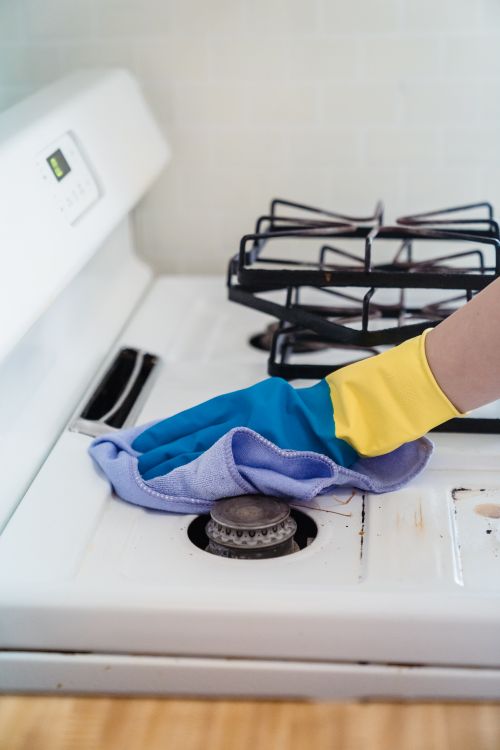
A practical after-cooking reset may include turning every control off, moving the cooled pan, putting food away, and removing fresh splatters once the appliance is safe to touch. A deeper clean may involve grates, burner caps, drip pans, knobs, or the area beneath removable parts. The correct steps depend on whether you have a gas, coil, glass, or induction surface.
Write a one-sentence finish line
Use a standard that both people can see: “After cooking, the controls are off, the area is cool, and visible food or grease from that meal has been cleaned according to the manual.” This is clearer than “leave the kitchen nice.”
The site’s guide to dividing household chores without resentment explains why ownership should include noticing and finishing, not waiting for the other person to inspect the work.
Use the instructions for your actual cooktop
Do not assume one viral cleaning mixture is safe for every surface. Coatings, sealed burners, glass tops, grates, ignition components, and removable parts have different requirements. Check the owner’s manual before using a scraper, abrasive pad, degreaser, or homemade cleaner.
Whirlpool’s general stovetop guide, for example, separates methods for gas and electric appliances and repeatedly points owners back to model-specific care instructions. Your own manufacturer’s guidance takes priority, even if a social media video looks faster.
Turn the appliance off and let it cool as directed before cleaning. Do not spray liquid into controls, igniters, electrical openings, or vents. Never mix cleaning products. If you smell gas, suspect a damaged connection, see a cracked cooktop, or notice a burner behaving abnormally, stop using the appliance and follow the manufacturer’s emergency or service guidance.
Decide whether the cook cleans or hands off
“Whoever cooks also cleans” sounds simple, but it is not the only fair system. Cooking can include planning, shopping, preparation, serving, and managing several pans at once. In some homes, one partner cooks while the other resets the kitchen. In others, the cook handles the stove and a partner handles dishes.
Choose the division that fits the total workload. The problem is not that one person touches the cloth instead of the other. The problem is an invisible handoff in which both people believe the other owns the greasy surface.
Make the handoff explicit
Say, “I cooked and put the food away. Can you take the dishes and wipe the cooktop after it cools?” The receiving partner should answer with a real time, not a vague “later.” If they cannot take it, renegotiate before the task disappears from view.
If you alternate cooking, you might include the quick stove reset in each cooking turn and alternate the deeper clean weekly. If one person cooks most nights, assign an equivalent kitchen job to the other person so that competence does not become a permanent penalty.
Choose timing that is safe and believable
The surface may be too hot to wipe immediately. That does not mean the task has to wait until tomorrow. Link cleanup to a reliable event: after dinner, after the dishwasher is loaded, or when the heat indicator turns off and the manual says cleaning is safe.
A specific delay protects both safety and trust. “I will wipe it after we eat, once it is cool” gives the other person a usable expectation. “I will get to it” often means somebody else finds the residue at the next meal.
If one partner needs the stove early in the morning, agree that the evening reset ends before bed. If you both cook at different times, set a rule that each person leaves at least one usable burner and the surrounding preparation area ready for the next meal.
Remove the practical barriers to cleanup
Look at what happens after the pan leaves the burner. Is the approved cleaner in another room? Are all the cloths already wet? Does the grease need a short cooling period that makes it easy to forget? Is the cook carrying food to children while the meal is still hot?
Put the correct supplies in a safe, accessible place near the kitchen, away from heat and children. Use a timer if cooling creates the gap. Consider a splatter screen when appropriate for the food and cookware. A spoon rest and a clear landing spot for oily utensils can prevent a second trail across the counter.
Do not turn reminders into supervision
One neutral reminder is enough: “The front burner still needs its wipe when it is cool.” Repeating the request every few minutes, standing over the cleanup, or redoing it while criticizing the method creates a parent-child dynamic.
The partner who accepted the task has a responsibility too. A reminder should not become an excuse to debate tone while the agreement goes unfinished. Complete the task, then discuss how you want reminders handled in the future.
Agree on a shared minimum, not one person’s ideal
People notice grease differently. One person sees a few droplets as normal evidence that dinner happened. The other sees a sticky job that gets harder if it sits. Neither observation proves love, maturity, or respect.
A shared minimum should be functional: controls are unobstructed, loose food is removed, fresh grease is addressed safely, and the cooking area is ready for normal use. Polishing every metal surface after every meal may be an optional preference unless your appliance requires more care.
If the stricter partner wants an extra shine, decide whether they will do that finishing step, trade it for another task, or schedule it less often. The looser partner still has to meet the agreed baseline. Compromise does not mean the same person quietly finishing every job.
Keep this conflict separate from other kitchen messes
Grease on the cooktop may arrive with dishes in the sink, crumbs on the counter, and splatters in the microwave. Listing all of them at once makes the request hard to follow and easy to resist.
Use the site’s specific plans when another sequence needs attention. The guide for a partner who leaves crumbs on the counter focuses on the preparation surface. The article about food splattered in the microwave separates fresh spills from appliance deep cleaning.
Test the stove agreement for one week. If it works, keep it. If it fails, identify the exact point of failure: nobody knew who owned the wipe, the cleaner was wrong, the surface stayed hot longer than expected, or the assigned time was unrealistic.
Know when the argument is no longer about grease
A forgotten splatter is ordinary. A recurring pattern in which one partner agrees, does nothing, and expects the other to finish may belong in a larger conversation about reliability and household labor. Use concrete examples and compare the whole workload rather than treating the stove as proof of every past disappointment.
Pause if either person starts shouting, insulting, threatening, blocking an exit, breaking objects, or using the cleaning issue to frighten the other. You do not need to continue a chore negotiation while you feel unsafe. Contact a trusted local resource or emergency service when appropriate. In the United States, the National Domestic Violence Hotline offers confidential support and safety-planning resources.
For an ordinary disagreement that keeps escalating, return to one behavior and one request. The site’s advice on resolving conflict as a couple can help you choose a calmer time and discuss one issue at a time.
Questions couples ask about greasy stovetops
Should the person who cooks always clean the stove?
No single division works for every couple. The cook can own fresh splatters, or one partner can cook while the other owns the kitchen reset. Agree before the meal ends, balance the total work, and make sure somebody clearly owns the final result.
What if the stove is still hot after dinner?
Wait until the appliance is safe to clean according to its indicators and manual. Attach the task to a later event, such as loading the dishwasher, and use a timer if needed. Safety is a reason to delay the wipe, not to abandon it.
What if we disagree about how clean is clean?
Set a functional minimum both people will follow: no loose food, fresh grease handled safely, controls clear, and the cooking area ready for use. Negotiate optional polishing separately.
What if my partner agrees but keeps leaving the grease?
Review the system once. Confirm ownership, timing, supplies, and what “done” means. If the same person still has to notice, remind, and finish, discuss the wider division of labor or consider support from a qualified couples counselor if both partners want it and the relationship is safe.
Use one rule for the next meal
Keep the first agreement small: the person assigned to the cooking reset checks that the controls are off, waits until the surface is safe, and removes the grease from that meal using the approved method. A separate person or schedule owns the deeper clean.
Try it for a week, then adjust the handoff rather than attacking each other’s standards. A clear finish line will not solve every household disagreement. It can stop one greasy burner from carrying the weight of all of them.