

Quick answer: If your partner talks through movies, decide before pressing play whether this is quiet viewing, a social rewatch, or background television. For a movie you both want to follow, agree to pause for questions and save longer comments for natural breaks. Use subtitles or a short rewind when someone misses a line. If your viewing styles remain different, watch some titles together and others separately instead of making every movie night a test of compatibility.
The opening scene starts. Thirty seconds later, your partner asks where the story takes place. Then they predict the ending, explain why an actor looks familiar, and reach for their phone to verify it. You have already missed the next line. When you ask for quiet, they hear rejection. When they keep talking, you feel as if the movie you chose has become a podcast you never requested.
This disagreement sounds trivial until it ruins the little leisure time you share. The problem is usually not that one person is rude and the other is uptight. People use television differently. Some focus closely. Some react out loud. Some treat a familiar show as a setting for conversation. A workable movie night starts by naming which experience you are trying to have.
Say what you need before the movie starts
Do not wait until the fifth interruption, when your request is likely to come out as “Can you ever stop talking?” Ask before you begin: “I have been looking forward to this one and want to hear the dialogue. Can we keep comments short and pause if either of us has a question?” Your partner can answer that request without defending every previous movie night.
Be honest about the type of attention you want. If you hope to follow a mystery closely, say so. If this is a comedy you have both seen, talking may be part of the fun. “Watching together” does not automatically mean the same behavior for every title.
The person who likes to talk should also describe what makes the experience enjoyable. Maybe reacting is how they connect. Maybe they ask questions because they cannot hear the dialogue or keep track of faces. Maybe sitting silently for two hours feels less like time together than expected. An explanation does not erase the interruption, but it gives you a real problem to solve.
Choose a viewing mode
A simple label can prevent a surprisingly long argument. Pick one of these modes before pressing play:
- Quiet viewing: brief reactions are fine, but questions and side stories wait for a pause.
- Social viewing: comments, jokes, and predictions are expected, and either person may pause when dialogue is missed.
- Background viewing: the program can run while you eat, fold laundry, or talk, and nobody expects to catch every line.
You do not need a formal meeting about every episode. A quick “quiet one or chatty one?” is enough. The label is especially useful when one person thinks the evening is a date and the other thinks the screen is merely filling silence.
Agreeing on a mode also makes correction less personal. “Can we go back to quiet mode?” points to the plan. “You always ruin movies” turns one comment into a judgment about your partner.
Pause instead of talking over dialogue
If a comment needs an answer, pause. The pause button is less disruptive than raising your voices over the soundtrack and then rewinding because neither person heard the scene. Give the person holding the remote permission to stop without being accused of making the evening too serious.
Keep pauses proportionate. A ten-second question does not need a seminar. If a story about the actor’s entire career appears, write down the thought or save it for the end. Some couples use scene changes, ad breaks, or the halfway point for longer conversation.
For a theater, the rule is simpler: comments wait until the movie ends unless there is an urgent practical or safety need. Other people paid to hear the film. If one of you strongly prefers talking, choose home viewing for titles likely to invite a running commentary.
Separate questions from predictions and spoilers
Not every interruption lands the same way. “What did they say?” may signal an audio problem. “That character is obviously the killer” can spoil the suspense. A joke may be welcome once and exhausting every two minutes. Identify the specific behavior instead of banning all sound.
Agree that genuine clarification questions get a pause. Predictions can wait until the end of the scene, especially during mysteries, sports, or reality competitions. If one partner has already seen the title, they should not confirm, deny, smirk at, or “accidentally” steer the other person’s guesses.
Spoilers include more than revealing the ending. Saying that a scene is not important, warning that something sad is coming, or announcing that a character survives can change the experience. Ask before sharing anything learned from trailers, reviews, social media, or a previous viewing.
Fix hearing and comprehension problems without embarrassment
Dialogue can be hard to follow because of sound mixing, accents, background noise, hearing changes, auditory processing differences, attention, fatigue, or an unfamiliar story. Do not assume a question means your partner was not trying. Turn on subtitles, reduce room noise, adjust the volume, or rewind the line.
Subtitles are a tool, not a punishment. Choose readable text and make sure it does not cover important screen information. If one person finds captions distracting, try them for dialogue-heavy scenes or use headphones and an audio-sharing setup that still lets both people watch together.
If hearing difficulty is new, persistent, or affecting daily communication, the person concerned can speak with an appropriate licensed healthcare professional. A partner can notice a pattern and offer support, but should not diagnose a condition from movie-night questions.
Put phones under the same agreement
A partner may stop talking and then start reading headlines aloud, showing clips, or asking what they missed while scrolling. Decide whether phones are away, face down, or available only for urgent calls. Apply the rule to both people.
If somebody needs to check a message, pause or let the movie continue with no promise to recap every scene. The person who chose to scroll can accept missing a detail. The other person does not need to become a live narrator.
Phone conflict often extends beyond television. Our guide to setting phone boundaries without policing each other can help you make a broader agreement that respects availability, privacy, and shared time.
Notice when talking is an attempt to connect
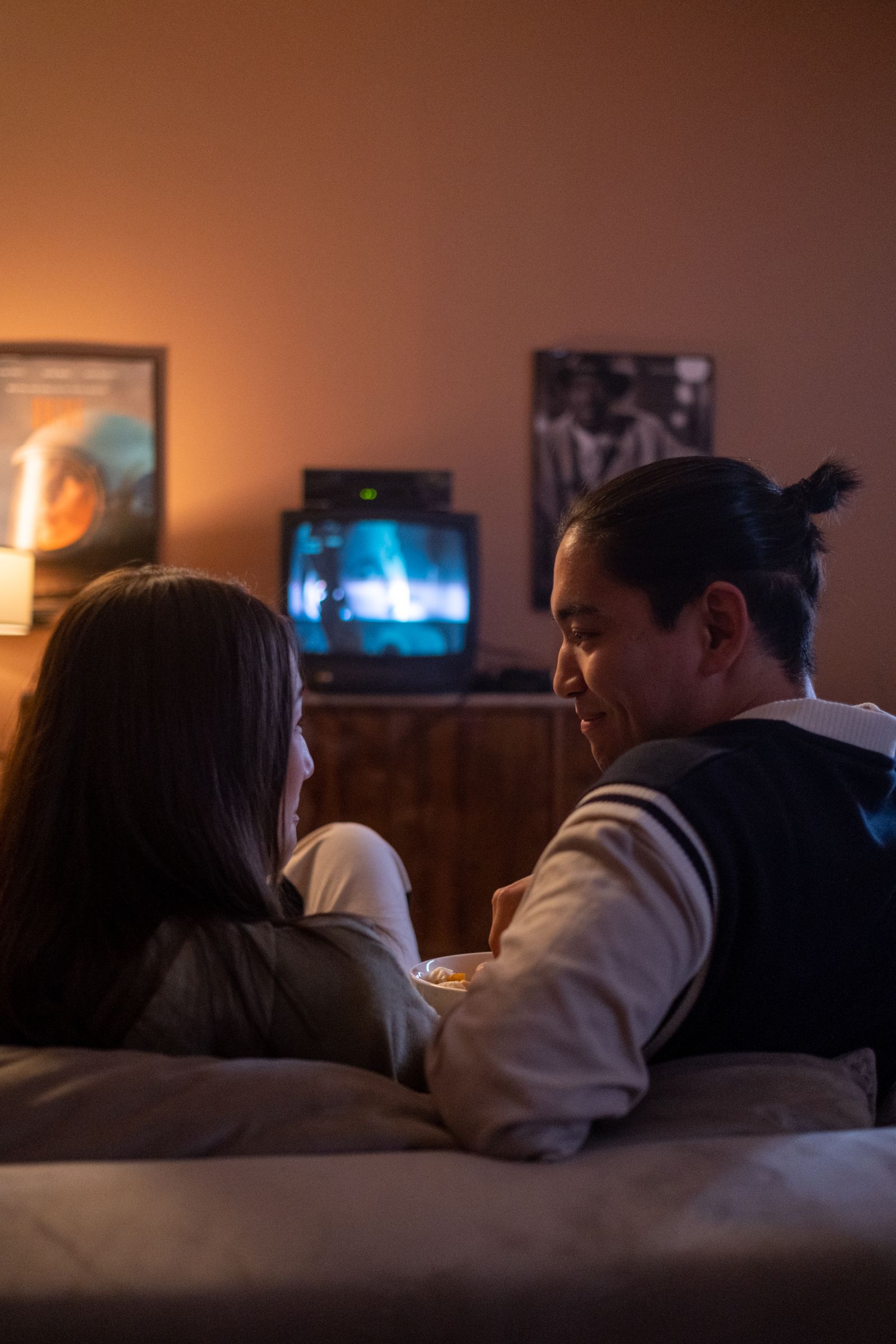
Sometimes commentary means, “I want to share this with you.” The talkative partner may be offering jokes, memories, theories, or bits of information as bids for attention. A flat command to be silent can feel colder than intended, especially if the couple has had little time together all week.
You can acknowledge the bid without sacrificing every line: “I want to hear your theory. Let me pause after this scene.” Then follow through. The focused viewer gets continuity, and the social viewer gets a response rather than a shush.
It may also help to create ten minutes of conversation before the movie. Put away the remote, check in about the day, then start. If one partner has been waiting all evening to talk, expecting instant silence once the streaming menu opens is likely to fail.
Do not use the remote as a weapon
A remote gives one person control over volume, pausing, rewinding, and whether the program continues. Avoid yanking it away, hiding it, turning the volume up to drown out your partner, or repeatedly pausing as a sarcastic punishment. Those tactics turn a preference dispute into a power struggle.
Choose a neutral remote rule. The person who selected the movie can hold it, or place it between you where either person can pause. If one person needs accessibility controls, set those before viewing. Nobody should have to ask permission for a necessary accommodation.
If your partner keeps speaking while you are answering or talks over you outside movie night, the screen may not be the main issue. Our article on what to do when your partner keeps interrupting offers a turn-taking method for ordinary conversations.
Let some entertainment stay separate
Couples do not need identical viewing habits. You can keep a few shows for quiet shared watching, choose chatty comfort shows for casual evenings, and watch certain titles alone or with friends who enjoy the same style. Separate viewing is not evidence that the relationship is failing.
Protect the shared list by choosing titles both people genuinely want to watch. Resentment grows when one partner sits through the other’s favorite series under an unspoken rule that they must stay attentive and enthusiastic. Trade choices, set a time limit, or stop a show that neither of you is enjoying.
If one person wants quiet solo time after work, say that directly rather than using a movie as a barrier. The approach in our guide to asking for alone time without making your partner feel rejected can help separate a need for decompression from a rejection of the relationship.
Address contempt, intimidation, or control directly
Most movie-night disagreements are ordinary preference conflicts. Still, mocking a partner’s hearing, deliberately spoiling stories to upset them, refusing accessibility needs, screaming when someone pauses, or controlling all entertainment as a punishment is different. The problem is the harmful behavior, not streaming etiquette.
If you feel afraid to speak, pause, leave the room, or choose what you watch, seek private support from a qualified local domestic violence service. Contact emergency services if there is immediate danger. Couples counseling may help with a normal communication conflict when both people can participate freely and safely. It is not a substitute for individual safety planning when coercion or violence is present.
Frequently asked questions
Is talking during movies disrespectful?
It can feel disrespectful when someone keeps talking after a clear request for quiet, especially during important dialogue. It can also be a difference in viewing style rather than an intention to dismiss you. Agree on the mode before the movie and judge the follow-through, not the habit in isolation.
What if my partner asks questions the movie has not answered yet?
Try a shared phrase such as “the movie has not told us yet.” If the question is about a missed line, pause and rewind. If it is a prediction request, save it for the next break so neither person has to explain information the story is still building.
Should we use subtitles?
Use them if they help either person follow dialogue. Test font size, placement, and contrast when the service allows it. If captions distract one viewer, try a short test rather than rejecting them outright, especially when hearing or processing needs are involved.
What if my partner gets offended when I ask for quiet?
Make the request before viewing and include connection: “I want to watch this with you, and I also want to hear it. Can we pause when we want to talk?” Ask what talking adds for your partner, then choose a format that gives both of you some of what you want.
Is it okay to watch movies separately?
Yes. Shared entertainment is one way to spend time together, not an obligation. Keep some mutual choices if you enjoy them, and allow separate viewing when the title or attention style is a poor match.
Try a one-movie experiment
For your next movie, choose the viewing mode before pressing play. Put phones in the agreed place. Use subtitles if either person wants them. Pause for questions, save longer stories for a break, and avoid predictions that could become spoilers.
After the credits, ask two questions: “What helped you enjoy it?” and “What became annoying?” Change one rule for next time. Movie night does not need a constitution. It needs a small agreement that lets one person follow the story and the other person feel they are sharing it with someone, not sitting through two silent hours beside a stranger.