
Quick answer: If your partner leaves cardboard boxes unflattened, define when a delivery is finished, keep one safe breakdown spot, and give each box a clear owner. The person who opens a package should usually remove the contents, separate the packing materials, flatten the clean cardboard, and place it where your local recycling program requires. If a box is too large, heavy, wet, or difficult to cut safely, ask for help rather than turning the task into a test of commitment.
A delivery arrives. The useful item comes out, but the box stays beside the door. Soon it has company: a shoe box, two shipping cartons, plastic air pillows, and a long box that blocks the hallway every time someone carries groceries inside. One partner sees a five-minute job. The other sees something that can wait until recycling day.
The argument is rarely improved by calling the pile lazy, disrespectful, or ridiculous. Cardboard is a practical problem with visible steps. Treating it that way gives you something more useful than another debate about personality.
Name the exact problem before discussing fairness
Start with what happened and where it caused trouble. You might say, “Three delivery boxes have been beside the entryway since Saturday, and I have moved them twice to use the door.” That describes the event. “You dump everything on me” invites a trial about every chore either of you has completed.
Then name the effect. Unflattened boxes may take over a shared room, fill the recycling cart, conceal packing materials, or create a tripping risk in a narrow walkway. Shipping labels can also display names and addresses. These are concrete reasons to agree on a routine. You do not need to prove that one partner is a bad housemate before asking for a clear finish line.
If the box pile is one part of a larger disagreement about cleaning, use a broader conversation about dividing household chores without resentment. Trying to solve the entire household through one cardboard argument usually leaves both the boxes and the resentment in place.
Decide when a delivery is actually finished
People often use different definitions without realizing it. For one person, the delivery is finished when the item is on the kitchen counter. For the other, it ends when the item is stored, the receipt is handled, the packaging is sorted, and the box is ready for collection.
Write a short finish line that fits your home. For example: open the package, check that the order is correct, keep any box needed for a return until the return window is settled, remove non-cardboard packing, flatten recyclable cardboard, and put it in the assigned place. The point is not to create a household policy manual. It is to stop relying on one partner to notice and complete the invisible final steps.
Separate return boxes from recycling
Some boxes should not be flattened immediately. An appliance, computer, or fragile item may need to be tested before its packaging is discarded. Choose one limited “possible return” area and add a decision date. A box without a date can become permanent furniture.
When the return period passes or you decide to keep the item, the owner of the purchase handles the packaging. If you routinely order household supplies together, agree on who owns that reset before the next delivery arrives.
Check your local recycling rules
Cardboard rules differ by municipality, building, and waste provider. The U.S. Environmental Protection Agency advises people to check local recycling requirements and generally recommends emptying and flattening cardboard boxes. Its guide to recycling common household materials is a useful starting point, but your local program has the final say.
Clean, dry corrugated cardboard is commonly accepted. Wet, moldy, wax-coated, heavily food-soiled, or mixed-material packaging may require different handling. Plastic air pillows, foam inserts, bubble wrap, insulated liners, and loose film are not cardboard merely because they arrived inside a box. Remove them and follow local instructions for reuse, drop-off, or disposal.
Do not turn uncertain rules into a couple dispute
If one of you says tape must be removed and the other says it can stay, check the provider’s current instructions. Do the same for pizza boxes, staples, labels, oversized pieces, and cardboard placed beside a full cart. A two-minute lookup is better than each partner defending a rule remembered from a different city.
Create one safe place to break boxes down
Choose a spot with enough room to work without blocking a doorway or spreading debris across a food-preparation surface. Depending on the home, that might be beside the recycling bin, in a utility room, or in a dry part of the garage. Apartment residents may need a smaller indoor station and a regular trip to a shared recycling area.
Keep the setup simple. A container for loose paper and an assigned place for flattened cardboard may be enough. If you use scissors or a box cutter, store the tool safely and follow its instructions. Cut away from your body on a stable surface, keep fingers out of the cutting path, and keep blades away from children and pets. Do not leave an open blade on top of the cardboard pile.
Large appliance or furniture boxes can be awkward even when empty. Ask another adult for help, use an appropriate tool, or contact the waste provider about oversized material. No recycling routine is worth a fall, cut, or strained back.
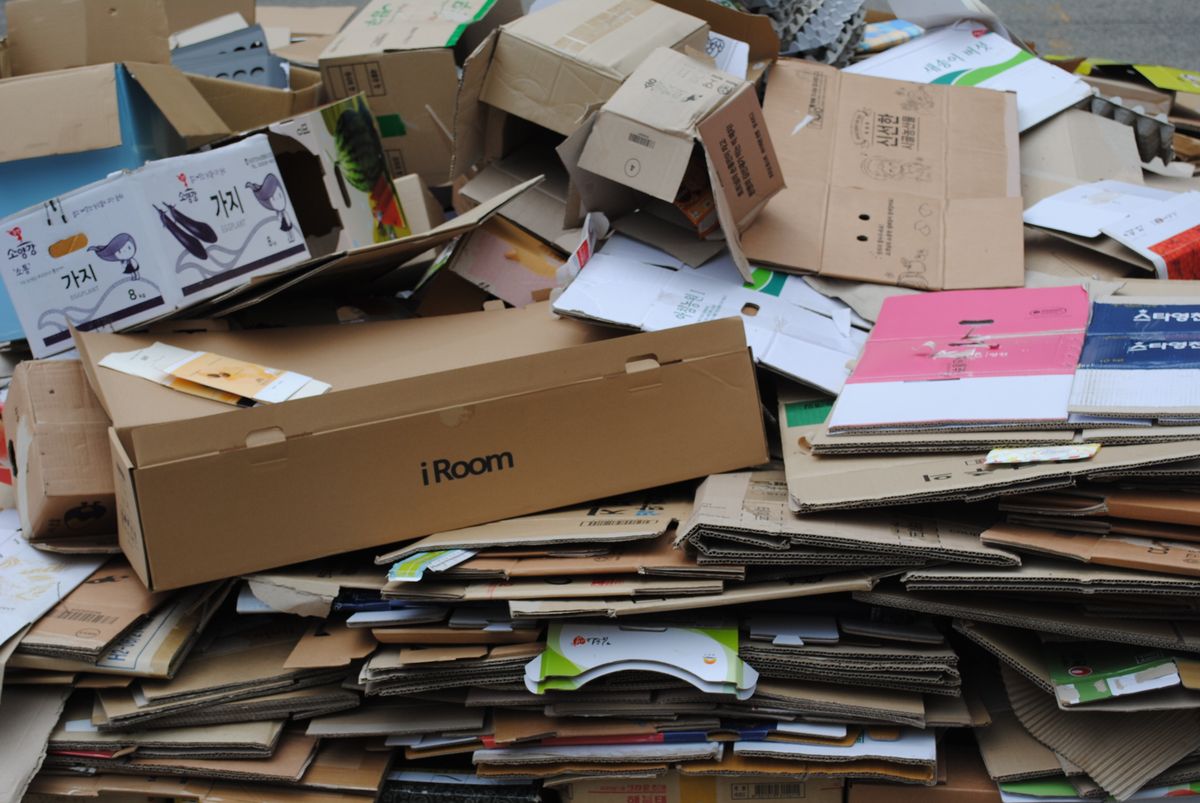
Assign ownership instead of waiting for someone to notice
A vague rule such as “we both deal with boxes” often means the more bothered partner deals with them first. Choose an owner for each predictable step.
The simplest version is opener owns packaging: whoever opens the delivery completes the reset. That works when both people order and open similar amounts. Another option is purchaser owns packaging, which can prevent one partner from inheriting boxes from the other’s frequent orders. You might instead assign one person weekly recycling and give the other a different complete household task.
The division does not need to be identical to be fair. It does need to be visible and agreed. Research on asking for and offering help with domestic chores shows how easily couples can differ over whether help should be requested directly or noticed without words. A named owner removes some of that guesswork.
Ownership includes the last step
Flattening a box and leaning it against the recycling cart may not be completion if collection rules require pieces inside the cart. Carrying boxes outside may not be completion if plastic packing remains scattered in the living room. Define the last step once so neither partner has to add it during every argument.
This is the same issue that appears when a partner never takes out the trash: the visible middle of the job is not always the whole job. Include noticing, preparation, supplies, transport, and follow-up in the assignment.
Use a trigger that both partners can see
“Do it soon” is not a deadline. Pick a trigger that fits the volume of deliveries and the collection schedule. Boxes might be handled immediately after opening, before bedtime, when the designated return shelf is full, or on the evening before recycling pickup.
Immediate breakdown keeps a small home clear but may be unrealistic when someone opens a package while rushing to work. A same-day deadline allows flexibility without creating an indefinite pile. A weekly reset may suit a garage, but only if the temporary storage area stays dry and does not block exits, utilities, vehicles, or shared access.
Add a recurring calendar cue if collection day is easy to miss. The reminder should alert the task owner, not appoint the other partner as a supervisor. A practical system should keep working when nobody feels like issuing another reminder.
Make room for different capacities
Breaking down boxes can be harder for someone with limited grip, chronic pain, fatigue, poor balance, pregnancy-related restrictions, low vision, or difficulty working close to the floor. Cardboard may also trigger dust sensitivities or feel overwhelming when deliveries have accumulated.
Adjust the task rather than arguing about whether it “should” be easy. One partner can remove packing materials and labels while the other flattens and carries the cardboard. Smaller scissors approved for the material may be safer than a utility knife for some people. Large boxes can be opened at the seams rather than forced flat. A building’s staff or local pickup service may offer another option.
Accommodation is not a free pass for the entire task to disappear onto one person’s list. Exchange it for another responsibility that the person can own from beginning to end.
Talk about delivery habits if the pile keeps growing
A perfect breakdown routine will still struggle if packages arrive faster than the household can process them. Look at the source without shaming each other’s purchases. Are several small orders replacing one planned order? Are subscription deliveries arriving before existing supplies are used? Are boxes being saved without a specific reuse plan?
You might combine orders when practical, pause an unneeded subscription, select minimal packaging where available, or set a limit for boxes kept for storage and returns. Reuse sturdy boxes only when you have a real purpose and a defined storage space. “This could be useful someday” is not a plan when the same box blocks the closet today.
For deliveries that include bills, warranties, or return paperwork, connect the packaging routine to your system for handling household mail and deadlines. Remove documents before the box enters recycling, then give each paper an owner and due date.
Use one direct request, not running commentary
Choose a neutral time and ask for a specific change. Try: “I need the entryway clear. Can we agree that the person who opens a package handles its box by the end of the day?” That is easier to answer than “Why do I always have to clean up after you?”
If your partner agrees but the box remains, refer to the agreement without adding a character judgment: “This box was opened yesterday and is still in the hall. Will you finish it by seven, or do we need a different owner?” A clear request leaves room for an honest answer. Sarcasm, photos sent as evidence, or repeatedly moving the box into your partner’s personal space usually adds heat without fixing the handoff.
What a useful apology sounds like
A useful apology names the missed action and the repair: “I left the boxes in the hall after we agreed I would flatten them. I will do that now and put tomorrow’s recycling reminder on my calendar.” The other partner does not need a dramatic promise. They need follow-through.
If you were sharp or insulting, apologize for that separately. Tone matters, and so does the unfinished task. Addressing one does not erase the other.
Set a boundary for repeated obstruction or safety risks
A boundary describes what you will do to protect access and safety. It is not a punishment designed to force compliance. You might say, “I will move boxes that block the doorway to the designated breakdown area, but I will not keep sorting all of your packaging. We need a routine you can complete.”
Handle immediate hazards first. Clear exits, remove exposed staples, secure sharp tools, and keep plastic film away from young children and pets. You can prevent an injury without silently accepting permanent ownership of every delivery.
Most box disputes are ordinary household friction. Pay attention if a partner deliberately blocks exits, creates hazards to frighten or punish you, destroys your belongings, threatens you when you raise the issue, or controls access to money, transportation, or sanitation. Those behaviors are not solved by a better recycling chart. Consider contacting a trusted professional or a domestic abuse resource from a safe device. If you are in immediate danger, contact local emergency services.
Try a two-week cardboard reset
For two weeks, choose one rule and test it. The person who opens a package checks the contents, places any return box in the dated return area, removes non-cardboard packing, flattens accepted cardboard by the agreed deadline, and takes it to the collection point. Put the local recycling link where both partners can find it.
At the end of the test, review the weak step. Did boxes wait because the cutting tool was unsafe? Did return packaging get mixed with recycling? Did the collection cart fill before pickup? Did one partner open packages addressed to the other and accidentally inherit the cleanup? Change that part instead of replacing the entire plan.
Frequently asked questions
Who should break down delivery boxes?
The person who opens or orders the package is often the clearest owner, but another division can work. Agree on the complete task and a deadline. Avoid a system in which one partner must notice every box and assign it.
Should boxes be flattened immediately?
Flatten recyclable boxes soon enough to keep shared areas usable, unless you may need the packaging for a return. Keep possible-return boxes in one limited area with a decision date. Follow local recycling requirements.
What if my partner says the boxes do not bother them?
The standard for a shared space is not whichever person tolerates more clutter. Discuss access, safety, collection limits, and how much temporary storage the home can support. Agree on an observable limit rather than asking either person to adopt the other’s comfort level.
How do we stop arguing about the same boxes?
Replace repeated reminders with an owner, trigger, finish line, and backup plan. If the agreement is repeatedly ignored, discuss reliability and the wider division of household work at a calm time. Couples counseling may help when the conversation keeps collapsing into contempt, intimidation, or scorekeeping.
Keep the goal ordinary
The aim is not to make both partners care about cardboard equally. It is to keep the home usable without one person becoming the permanent packaging manager. One owner, one safe work area, one visible deadline, and local recycling instructions can do more than another argument beside the front door.